· Cultivars · 7 minutes
Purple tea. Anthocyanins. Zi Ya, Zi Juan, and Zi Jian
Along with tea plant varieties whose young shoots have a light green color, there are also those in which buds and young leaves have a reddish, violet, or burgundy color. This is due to their high anthocyanin content.
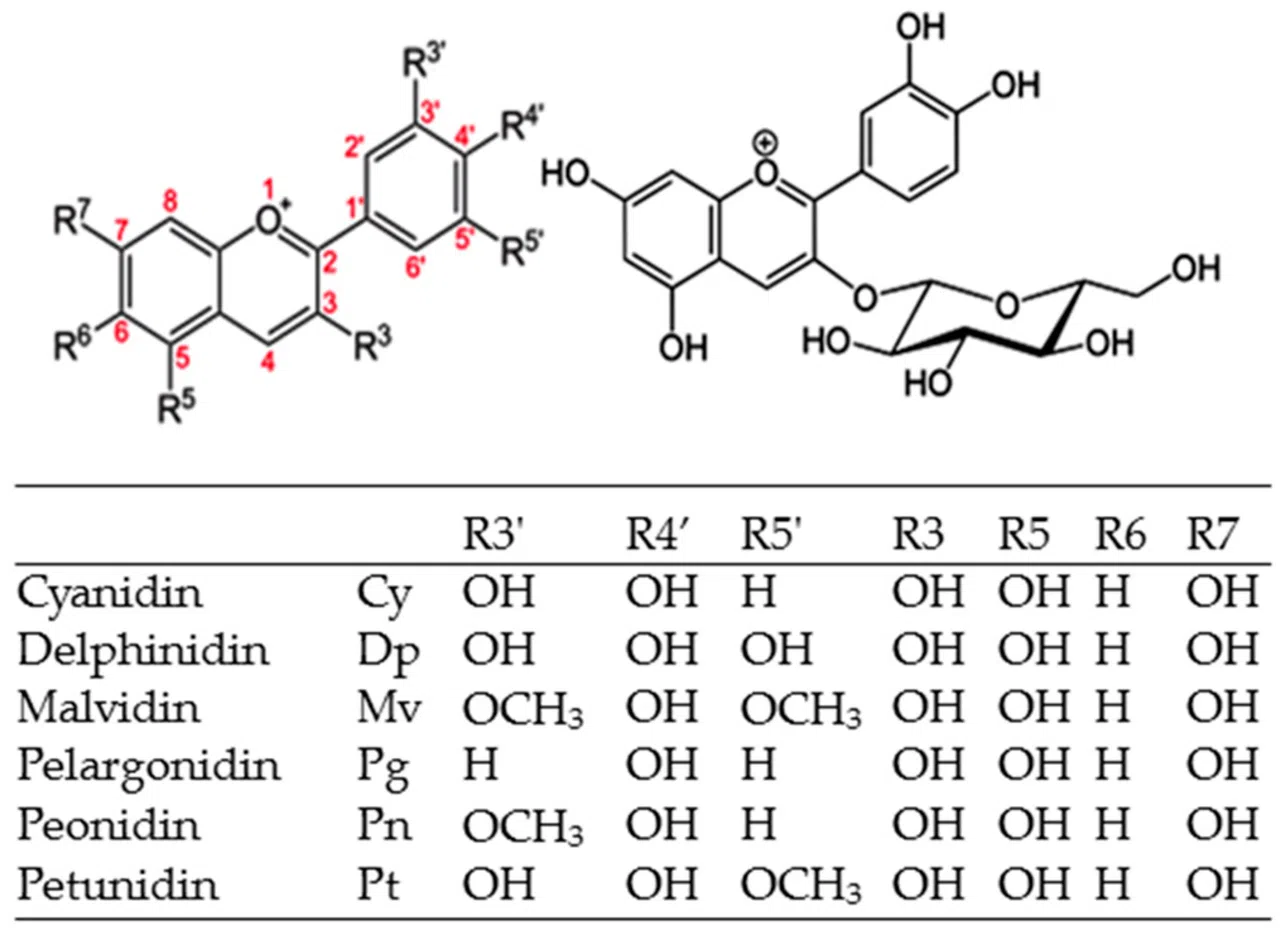
Anthocyanins are the most important plant pigments (alongside carotenoids and betalains), widely distributed in nature. Red, violet, pink, blue, and navy flowers, ripe fruits, the colors of autumn leaves – anthocyanins are responsible for all of this. Anthocyanins are glycosides, meaning their molecules consist of a non-carbohydrate part (aglycone) and a carbohydrate moiety, which can be represented by mono- (glucose, galactose, rhamnose), di-, and trisaccharides; anthocyanin molecules may also contain other fragments – for example, caffeic acid residues. The aglycones of anthocyanins are called anthocyanidins and belong, like catechins, to the flavonoids; at their core lies the 2-phenylbenzopyran structure, in which some hydrogen atoms in the three rings can be replaced by hydroxyl or methoxyl groups. The color of the pigment depends on the number and type of these groups, but the palette possibilities of anthocyanins are not exhausted there. The color is also influenced by other parts of the molecule and the pH of the environment (some anthocyanidins have up to 4 color transitions depending on the pH of the medium), and the presence of metal ions (aluminum, iron, magnesium, molybdenum, tungsten). This is why the coloring of flowers, fruits, and leaves is so diverse.
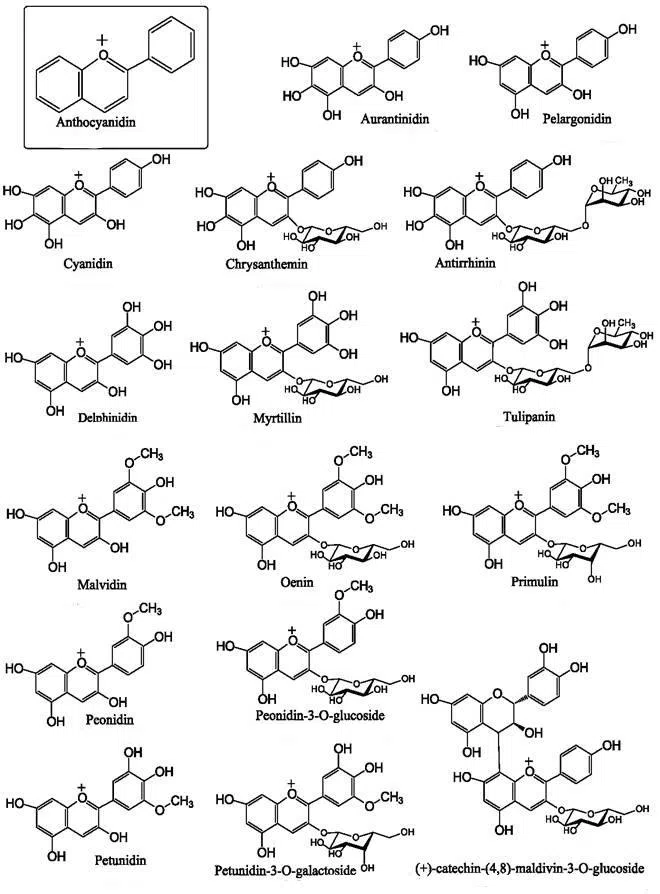
Anthocyanin biosynthesis is complex – more than two hundred proteins are directly or indirectly involved [1], but it is fairly well studied, which makes it possible to create new plant varieties with unusual colors. There is no full clarity regarding their function. It is obvious that colored flowers attract pollinators; but why is the reddish or violet coloring of young shoots needed? Anthocyanin synthesis is often enhanced by stress factors – high or, conversely, low temperatures, drought, and especially intense direct sunlight. It has been suggested that anthocyanins may protect delicate plant tissues from excess UV radiation and help stabilize photosynthesis.
In tea plants, anthocyanidins such as pelargonidin, cyanidin, delphinidin, peonidin, malvidin, and others have been found. They are present in the leaves of ordinary green-leaf varieties, but in small quantities – about 0.01% – so they do not affect their color. In the leaves of purple tea plant varieties, the concentration of anthocyanins is 50-100 times higher, reaching 0.5-1%. The final leaf color depends on the anthocyanin structure and concentration, but also on the ratio of chlorophyll A to B and other factors, and varies considerably depending on growing conditions. As a rule, the red or violet tinge of buds and the first 2-4 leaves on a shoot is pronounced when the leaf is young and growing. Mature, last year’s leaves have the usual dark green color.
Attitudes toward purple tea raw material have varied across different periods of tea history. A high appraisal of purple tea is given in the works of Lu Yu; other famous poets of the Tang dynasty – Qian Qi and Zhang Ji – also spoke positively of it. However, later, due to specific nuances of taste and aroma as well as unusual appearance, reddish buds and leaves came to be considered unconventional. Interest in them has grown in recent decades – partly due to the desire for everything original and exotic, and partly because of the medical potential of anthocyanins. They possess antioxidant properties, and therefore it can be assumed that they have anticancer effects. There are studies in which purple tea demonstrated a more pronounced ability to normalize elevated blood pressure compared to regular tea. But of course, it would be premature to speak of the healing properties of purple tea.
Purple coloring is more common among wild bushes that reproduce by seed, which is entirely understandable – for at least several centuries, mainly “standard” green-colored tea was selected for vegetative propagation and mass cultivation. Therefore, purple tea is primarily prevalent in Yunnan, because in Yunnan the share of wild tea in the tea industry is significant. Well-known examples include red teas from Yunnan and sheng puerh made from purple raw material; they have a strong, specific nuance of aroma and taste that can evoke associations with grapefruit, berries, or blackcurrant leaves – generally, it is easier to experience it than to describe it precisely. Green tea made from purple raw material is encountered less frequently, and as for shu puerh, the specificity of purple raw material does not manifest itself as clearly.
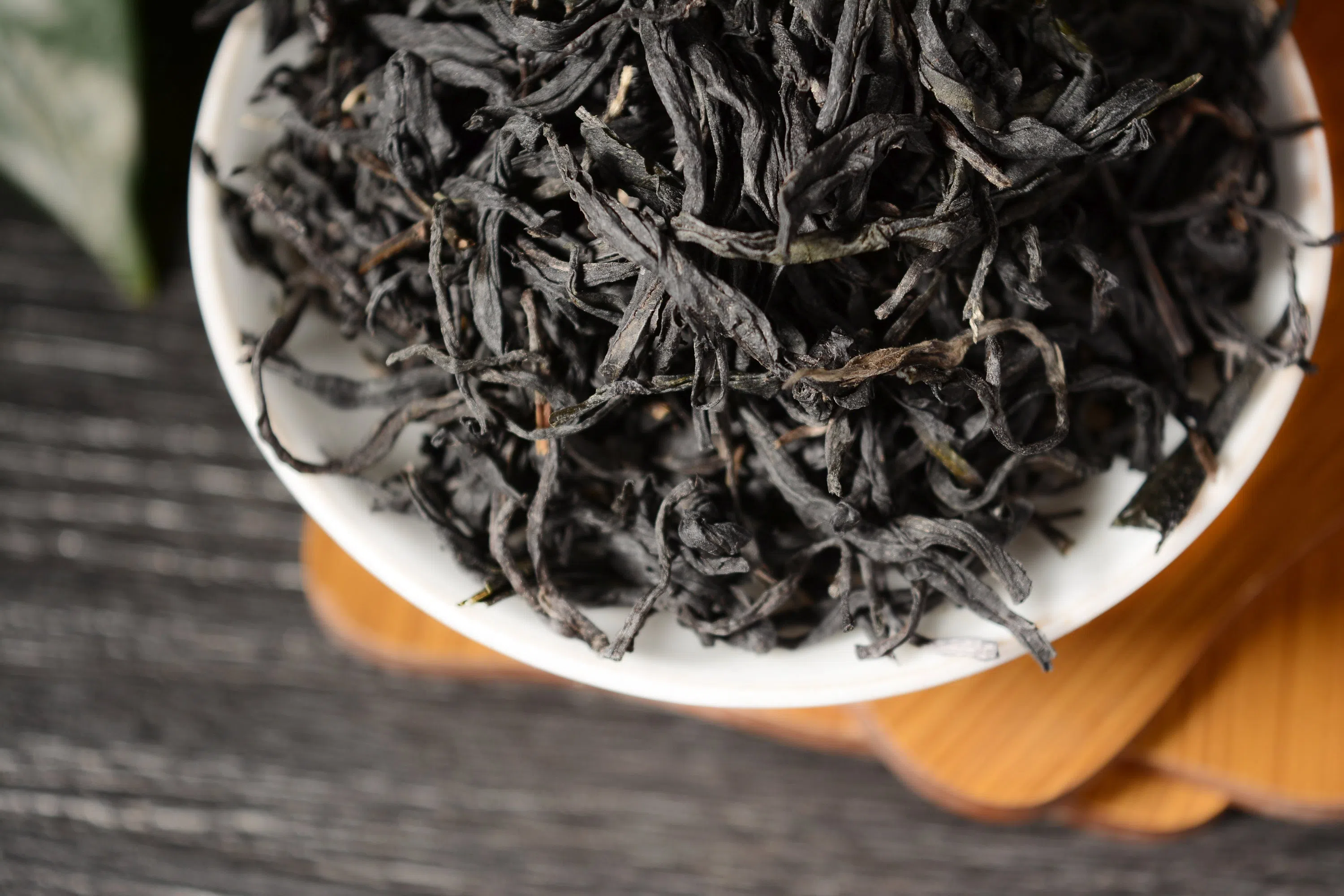
In 1985, in the Nannuo Mountains, researchers from the Tea Research Institute of the Yunnan Academy of Agricultural Sciences discovered a natural tea garden with a large number of trees exhibiting an exceptionally rich violet color of buds and leaves. Even the tea liquor made from raw material from these trees had a distinct lilac tinge. The anthocyanin content in the young leaves of these trees was several times higher still than in most known purple varieties – up to 2.9%. Through research and vegetative propagation of this population, the cultivar Zi Juan was created, which can be written in two different ways: 紫鹃 – “Purple Cuckoo” (with a reference to Zi Juan, the devoted maid of Lin Daiyu, one of the main heroines of “Dream of the Red Chamber”) and 紫娟 – “Purple Beauty”; currently both spellings exist and should be treated as synonyms. In 2005, the Zi Juan cultivar was registered. It is primarily grown in Menghai. Zi Juan belongs to the xiaoqiaomu type – a small, upright tree with large leaves and medium-sized buds, with a semi-spreading form, relatively thick branches, and a medium-density crown. The leaves are willow-shaped with pointed tips. The buds and leaves have a red-violet color that changes smoothly from spring to early winter; the plant has high ornamental value and can be used in landscape design. The finished tea is dark gray or nearly black with a bluish sheen, the liquor is gray-pink or lilac, and the “leaf bottom” is dark, gray-blue with a hint of indigo.
Unlike Zi Juan, the name Zi Ya (紫芽) – “purple buds” – does not refer to any specific variety but is usually a collective name for all purple tea varieties. In some sources, Zi Juan is included within the concept of Zi Ya, while in others, Zi Juan with its exceptionally dark color is contrasted with the rest of Zi Ya, in which the “leaf bottom” is not as dark and is more colorful, and the liquor color is closer to dark yellow, sometimes with a grayish tinge.
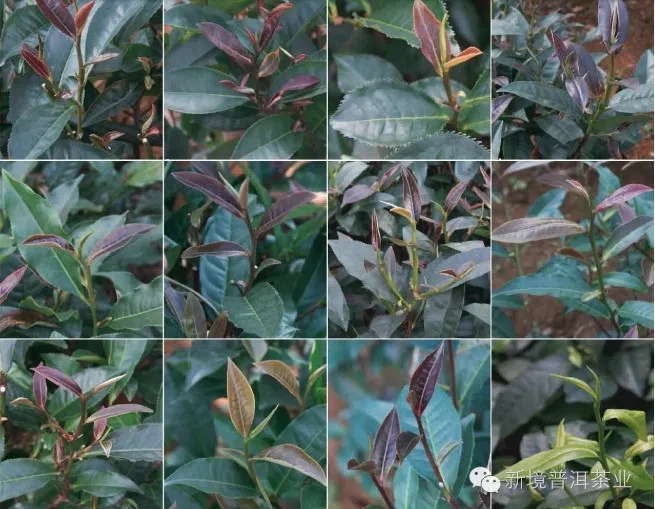
It should be noted that although 芽 in tea variety names often indicates that mainly or exclusively buds are used for tea production (for example, Manding Huang Ya, Fu Xi Gong Ya, Maitan Cui Ya), Zi Ya does not mean that the tea will consist only of buds. Zi Ya Cha is simply a designation for purple tea as a botanical phenomenon, as well as for the finished tea made from such raw material.
Sometimes the expression Yesheng cha (野生茶) – “wild-growing tea” – is used in reference to some purple tea plant varieties in Yunnan, Thailand, and Myanmar, which of course does not add clarity.
Another term is Zi Jian (紫尖), “purple tips,” which usually refers to the finished product. Most often it denotes purple sheng puerh with a picking standard of bud or bud+leaf, but the term has no strictly defined meaning. If you encounter it, it is best to simply treat it as a designation for purple tea.
”Zi” can be translated as both violet and purple. In this article, I use the translation “purple” because historically, purple in different regions and at different times referred to various shades of color from scarlet to dark violet, depending on the species of mollusks from which the purple dye was extracted. The color spectrum of Zi Ya Cha is almost equally wide.
In addition to purple teas from Yunnan, there is the Fujian cultivar Hong Ya foshou (红芽佛手) – “Buddha’s hands with a red bud,” as well as a number of other red-leaf teas from Fujian; Tai Xiang Zi (苔香紫) in Zhejiang; purple Ninghong; and others.
Source: Tea shop “Owl and Panda”