· Tea chemistry · 3 minutes
Fungi and bacteria in puer teas
While preparing for last year's 'Czaisz' festival, I found an interesting article, and only now I remembered that I wanted to share it.
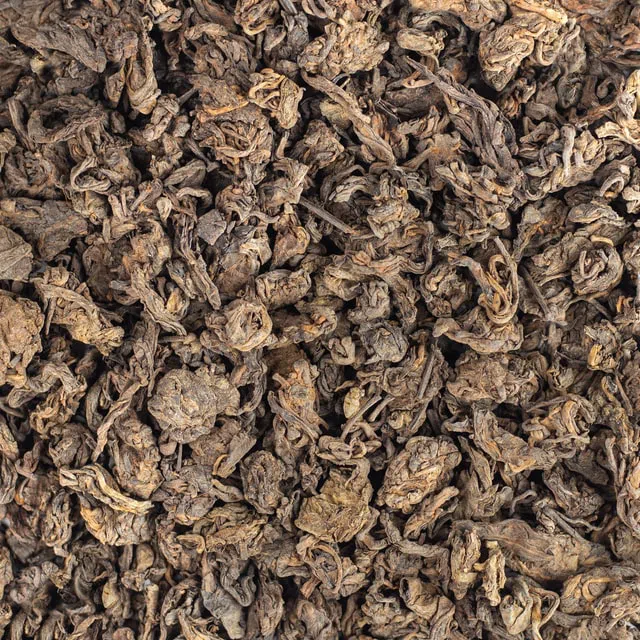
As I assume you know, puer teas can be divided into two categories: sheng, which closely resembles green tea in its early stages, and shu, whose production technology was developed in the 1970s in an attempt to find a method for rapidly aging sheng puers. It is based on a process known as wodui. The key stage of this process is semi-fermentation (since only anaerobic processes fall under the strict definition of fermentation, and during wodui there are both aerobic and anaerobic zones) of moistened tea leaves by bacteria and fungi present on the leaves. The topic of the definition of fermentation is complicated. The English “fermentation” can be used for both aerobic and anaerobic processes in food production, whereas the Polish definition is most likely based on Louis Pasteur’s monograph “Études sur la Bière,” in which Pasteur defines fermentation as referring only to anaerobic processes.
But let us return to puers. For these two very different subtypes of tea, there is one important thing in common – aging, lasting even several decades. Under the influence of bacteria and fungi, teas change their flavor during aging. Sheng becomes less astringent and more fruity-floral, while shu loses its earthy notes and develops date and caramel notes.
But have you ever wondered how many fungi and bacteria are present both in finished teas and in fresh leaves? It would be logical to assume that the microbiological composition of puers resembles that of raw leaves with minor variations.
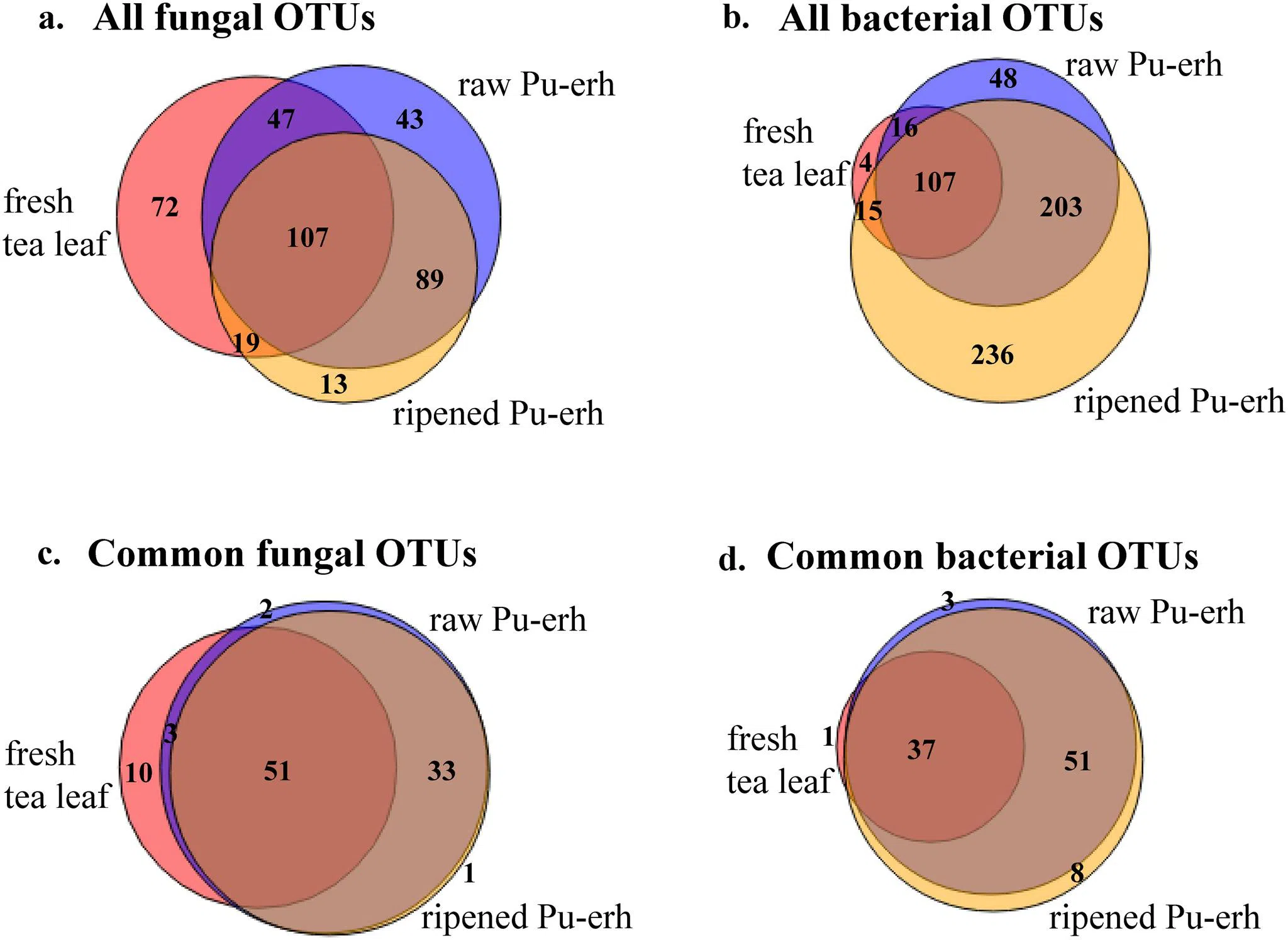
Scientists at Shanxi University, using high-throughput sequencing and quantitative metabolite analysis, identified the most prevalent fungi and bacteria in these teas. In total, they managed to identify 390 fungi and 629 bacteria, of which 107 were present in all 3 types of samples (sheng, shu, fresh leaves). 54% of fungi and 22% of bacteria from fresh leaves were also present in both types of tea, so one can conclude that fresh leaves are an important source of microorganisms for tea aging. It is also interesting that 236 bacteria are unique to shu puers, while for sheng this number is only 46. However, if we look only at the most prevalent bacteria, the teas are almost indistinguishable, with 8 and 3 unique bacteria for shu and sheng, respectively. The diagrams presented below explain these relationships better than I can.
Additionally, it is worth mentioning that the presence of tea plant leaves in this study was determined by identifying the rbcL gene, which encodes the enzyme RuBisCO (the most abundant enzyme on Earth, responsible for carbon dioxide fixation by plants). In the case of shu puers, the presence of banana, pine, and cabbage rbcL was also detected. Some of the identified fungi, such as Aspergillus niger, Aspergillus restrictus, and Penicillium citrinum, can produce mycotoxins that may be harmful to the human body. Most of the toxins found were present in the teas at very low concentrations. However, for example, aurantiamide acetate was found at high concentrations. It is relatively understudied but may have anti-tumor and anti-inflammatory effects. Patulin was also detected in 60% of shengs and 12.5% of shu at concentrations of ~1000 ug/kg. It may have cytotoxic and mutagenic effects. In brewed tea, the patulin concentration should not exceed the safe threshold (50 ug/kg), but in the case of puers, rinsing the dry tea with hot water before the actual brewing is highly recommended.