· Tea chemistry · 5 minutes
L-theanine metabolism in tea plant tissues
L-theanine is the most important amino acid in the tea plant, accounting for 40-70% of all free amino acids in tea and making a significant contribution to its taste, being responsible for sweetness and umami flavor.
L-theanine was isolated from tea in the mid-20th century, and fifty years later, properties such as enhanced relaxation, concentration and learning ability, hypotensive, antitumor, hepatoprotective, immunomodulatory effects, and even the promotion of new cell formation in the brain were discovered [1] , [2] , [3]. Although research data is not always sufficiently convincing or unambiguous, L-theanine is actively promoted as a dietary supplement.
The presence of L-theanine is often linked to the beneficial effects of tea, even though the content of this amino acid in tea is significantly lower than the amounts that could produce a noticeable effect. Moreover, full extraction of L-theanine from tea requires considerable time: it has been found that optimal extraction conditions are a tea-to-water ratio of 1:20, tea ground to particles of 0.5-1 mm in size; 80°C, 30 min [4]. As you can see, these conditions differ greatly from normal tea brewing. Nevertheless, the biosynthesis and transport of this amino acid in tea plants is a fascinating subject.
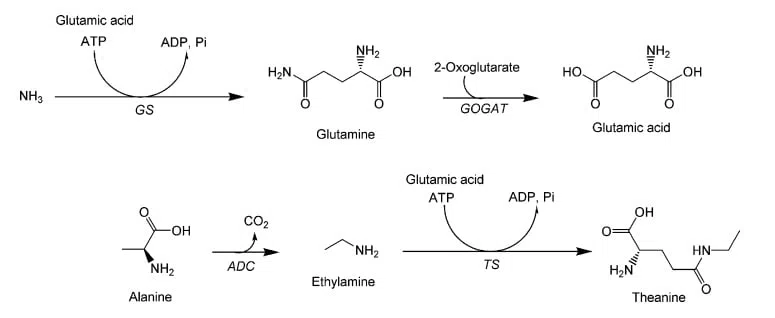
In the tissues of Camellia sinensis, L-theanine is formed from glutamic acid and ethylamine (see figure). This reaction requires energy derived from the breakdown of ATP (adenosine-5’-triphosphate – the main energy carrier in cells) and is catalyzed by two types of theanine synthetases that differ considerably from each other. The expression of theanine synthetase I in roots and shoots of young tea seedlings is comparable, while the expression of theanine synthetase II in shoots is significantly higher than in roots. Interestingly, theanine synthetase is clearly related to glutamine synthetase: theanine synthetase I is 99% homologous to glutamine synthetase III, and theanine synthetase II is 97% homologous to glutamine synthetase III [5]
Glutamine synthetases catalyze the energy-dependent synthesis of glutamine from glutamic acid and ammonia. Glutamine then reacts with alpha-ketoglutaric acid, yielding two molecules of glutamic acid (see figure 1, upper part); this reaction is catalyzed by glutamine alpha-ketoglutarate aminotransferase (GOGAT). This simple two-step cycle is the most important mechanism by which plants assimilate nitrogen from the soil.
The second substrate – ethylamine – is formed through the decarboxylation of alanine (Fig. 1, lower part). It is this compound that is the key element in L-theanine biosynthesis. Most plants contain both glutamic acid and the enzymes that catalyze L-theanine synthesis. When supplied with deuterium-labeled ethylamine, they begin producing deuterium-labeled L-theanine [6]. Clearly, it is the availability of ethylamine that accounts for the exceptionally high accumulation of L-theanine in tea leaves. Besides Camellia sinensis, notable amounts of L-theanine can also be produced by certain other species of Camellia, as well as by the fungus Xerocomus badius (note: current Latin name: Imleria badia – bay bolete).
In the first weeks of tea plant development from seed, L-theanine is synthesized in all parts of the plant, whereas in mature tea bushes, the roots are the primary site of L-theanine production. From the roots, theanine is transported to the leaves via the xylem, primarily to the leaves of young shoots. Most likely, there is a specialized biochemical system for its distribution and transport across extracellular and intracellular membranes – six L-theanine transporter proteins have been identified [7] [8].
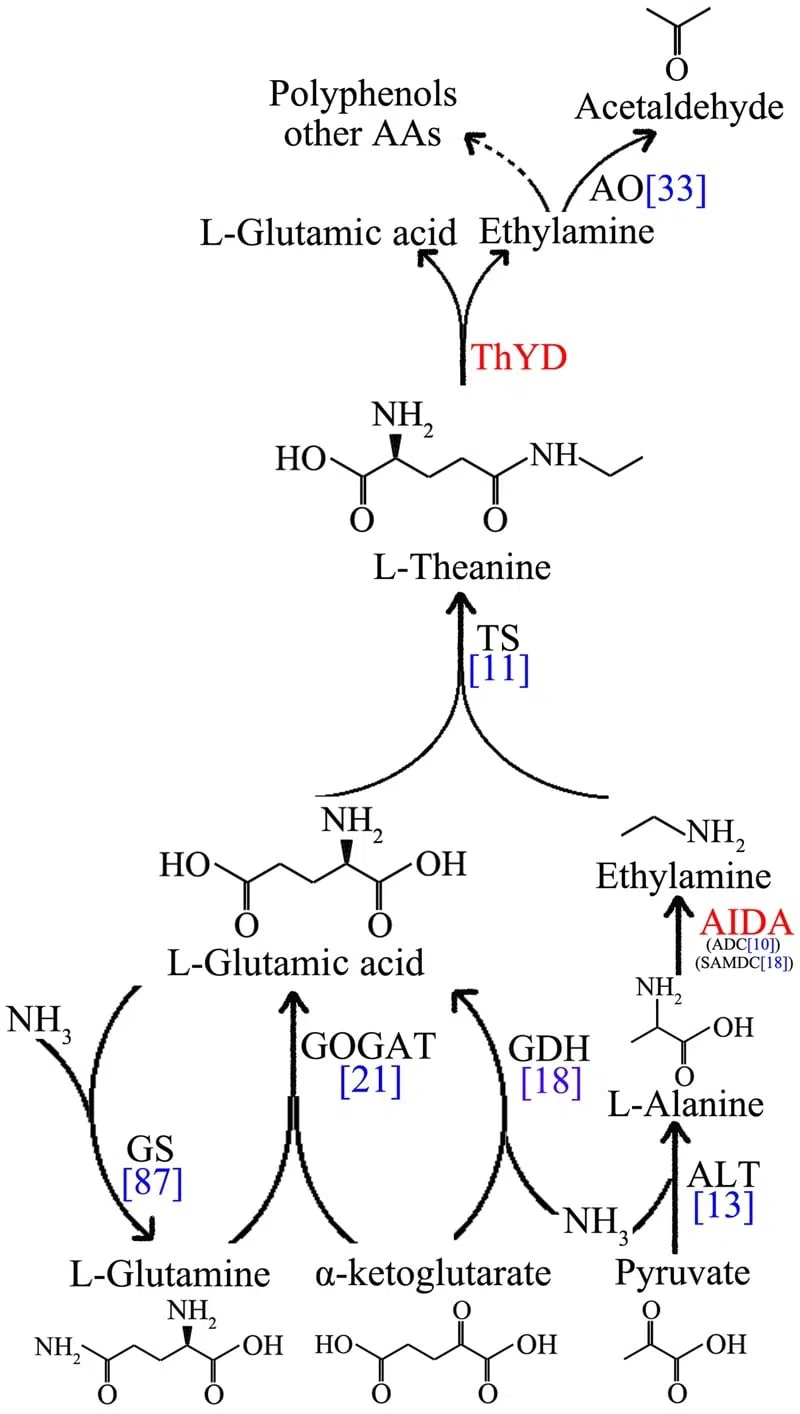
In the leaves, L-theanine undergoes hydrolysis to glutamic acid and ethylamine; the theanine hydrolase that catalyzes this reaction is still relatively poorly understood [9]. The ethylamine is then oxidized to acetaldehyde, which serves as a building block for the 1,3,5-trihydroxybenzene ring in catechins [10]. These processes depend on light exposure; reduced illumination hinders the conversion of L-theanine to catechins. This is partly related to the change in tea flavor during shading of bushes before harvest, a practice widely used in Japan.
In this way, L-theanine, owing to the ease of its formation and breakdown, serves as a temporary storage for both nitrogen and short hydrocarbon fragments, as well as a means of delivering them from the roots to the leaves of the tea plant, helping it flexibly adapt to environmental conditions. This is a unique biochemical “trick” of tea plants, and humans have partly contributed to its development by selecting for propagation and cultivation bushes that produce tea with a refreshing and slightly sweet taste. The entire “life cycle” of L-theanine is shown in the figure.
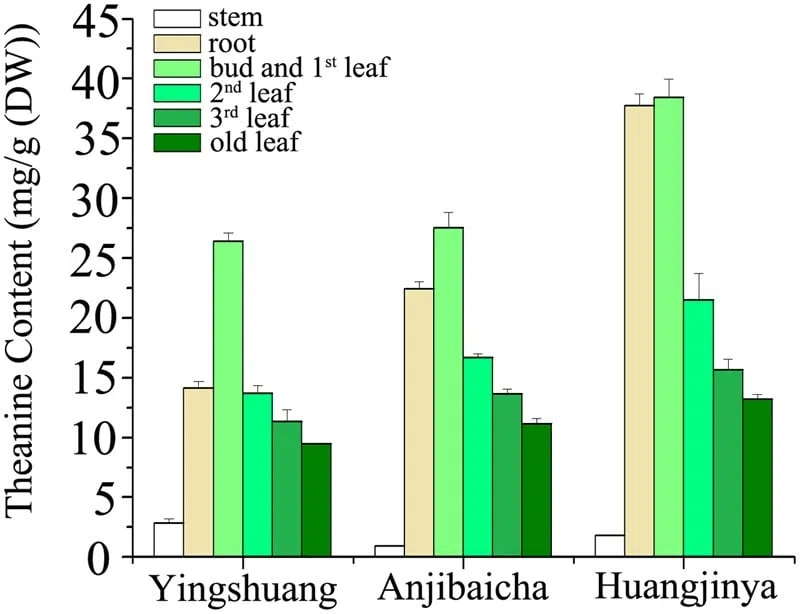
The content of L-theanine in tea also depends on growing conditions, the stage of shoot development, the season, and of course the tea plant cultivar. On average, small-leaf tea varieties are richer in amino acids, including L-theanine. In varieties with larger leaves, the amino acid content is somewhat lower. Yellow-leaf and white-leaf varieties in the phase of declining chlorophyll production are particularly rich in amino acids and L-theanine.
Over the course of a year, the highest content of L-theanine (in the plant overall, as I understand it) occurs in spring, then gradually decreases, with a slight increase in autumn. In winter, during the dormancy period, L-theanine accumulates in the roots. At the beginning of the growing season, it moves to the shoots, and until August its content in the roots remains low [11], [12]. The bud and the first leaf contain the maximum amount of L-theanine. As the leaf develops and grows, the L-theanine content decreases.
The content of L-theanine in tea leaves is positively correlated with soil nitrogen content and negatively correlated with light exposure [13]. If you have read the above carefully, you know why. For commercial purposes, technology for microbiological production of L-theanine using bacterial glutamine synthetases, gamma-glutamylmethylamide synthetase, gamma-glutamylmethylamide transpeptidase, and L-glutaminase is being developed [14].
Source: Tea shop “Owl and Panda”